Hi! I am Francis Coppola a sales manager in Jewelry Industry and I am working in this industry for last 5 years. I am not the owner of the content which has been published here. This content is only for knowledge purposes. This content belongs to the respective owners and I do not hold any right for this content.
Men’s Rings, From Dynastic Egypt to Hells Angels
Get link
Facebook
X
Pinterest
Email
Other Apps
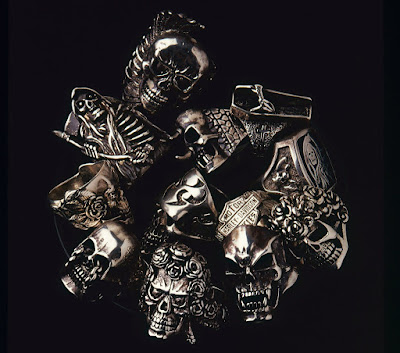
Silver rings made by Suzanne Gulliver
for the Hells Angels include representations of skulls with horns or
covered in flowers, and death with a scythe.
PARIS — Retro pop, midcentury modern,
vintage eclectic, Wunderkammer kitsch, transitional contemporary.
Whatever you call it, the style of decoration defies a single label and
yet you will be familiar with the tropes: cocktail-trolley Mad Men,
seasoned with Pop Art irony and some signature serious design (just in
case anyone was in doubt that aspect had been closely considered).
One
of the look’s great pioneers is Yves Gastou, who, back in 1986 — when
rich people were still collecting Impressionists and antique furniture —
opened a gallery in Paris decorated by Ettore Sottsass where pieces
from the 1940s and 1950s were mixed with the masters of Memphis.
What began as a
rebellion has, over time, become a sort of religion, of which Mr. Gastou
is a high priest. But this impish septuagenarian with his shock of
white hair would hate to hear himself described that way. “I buy things
ahead of fashion” he said, adding that he has “a need not to be like
everyone else.” It is a claim borne out by a new exhibition
he has curated — not of Brutalism, not of Modernism or even
Postmodernism, but of men’s rings, hundreds of men’s rings dating from
antiquity to today.
The exhibition is
scheduled to open Oct. 5 at L’Ecole de Van Cleef & Arpels, an
educational and exhibition space in the jeweler’s former offices just
behind the Place Vendôme in Paris. L’Ecole was the idea of Nicolas Bos,
Van Cleef’s chief executive. He describes L’Ecole as “an initiative or
platform around jewelry and art,” which offers courses in art history as
it relates to jewelry, classes on stones and workshops.
Jewelry stands to display necklaces can help you keep your jewelry sorted and tangle-free. Whether you need a display stand for personal use, or you make your own jewelry and attend craft shows, you have quite a few creative choices. Deciding What You Need You need to decide how many necklaces you wish to display and how tall and wide the stands must be to accommodate all of your necklaces. Some stands are designed to display only one necklace, while others can display multiple ones. If you need to purchase stands so you can participate in a jewelry or craft show, then chances are you have at least one or more necklaces that you wish to highlight as feature pieces. This type of display calls for a specific type of jewelry stand such as a bust or silhouette stand. If you own a jewelry store and need additional display fixtures, then you might want to be creative when it comes to selecting display styles. Whatever your needs, you can find quite a few attractive and creative w...
Notable Watch Index Styles Watches are comprised of so many intricate details from the inside out, some you may not even think of. From an aesthetic perspective, you might prefer a particular case material, dial color, or bracelet style. One element you might overlook is the watch’s indices. Indices are another way to refer to the watch’s hour markers. You may be surprised at how much different types of watch indices can impact the look of the dial. Here, we’ve compiled some common types of indices for you to consider. Arabic Numerals Arabic numerals are the most common symbols for numbers today, replacing Roman numerals. They can appear in watches in different forms. Sometimes, Arabic numerals may number each hour marker from one to twelve. Other watch designs use Arabic numerals at the three, six, nine, and twelve-o’clock positions. Occasionally, you’ll see only a single twelve-o’clock Arabic numeral marker. In some watches, elements like a date window or...
An elevator pitch is the cornerstone of jewelry sales that every small business owner needs. If you missed out on the binge-watching era of Shark Tank and other business competition TV shows this may be a new term for you. Fear not, this article will take a deep dive into pitching concisely with a compelling call to action. You’ll be a jewelry sales pro before you know it! What the heck is an elevator pitch? The proverbial elevator pitch gets its name from the dream scenario of starry-eyed entrepreneurs for decades. Imagine you land an entry-level job at a huge investment firm and you have a million-dollar, brilliant, world-changing business idea. If only you could get it in front of the bigwig decision-makers in the c-suite you would be in the money. You suffer the daily grind for months until one day opportunity leaps in front of you. The big boss races to catch the elevator you just stepped into on your way to work in the 3rd-floor mail room. She hits th...


Comments